Showing posts with label movie. Show all posts

Tuesday, 3 September 2019

Okay, Maybe That's Enough Fast And Furiouses For Now

Your browser does not support HTML5 video tag.Click here to view original GIFGIF: YouTube

One of the earliest signs that the Fast and Furious film franchise has finally flown too close to the sun comes within the first 10 minutes of Fast and Furious Presents: Hobbs & Shaw, the ninth installment in the now 18-year-old series.

Luke Hobbs, a greased bowling ball and bounty hunter (freelance) played by The Rock “Dwayne” Johnson, confronts his first victim by revealing how he learned of said victim’s illicit behavior: “I’ve been hearing a lot of dark web chatter,” he says, to the viewer’s deep humiliation. If you can imagine a gigantic steak in a too-tight denim jacket saying, “I’ve been hearing a lot of dark web chatter,” before pummeling some guy this way till Tuesday, then you know all you need to know about this already ill-conceived spinoff: It is dumb. Not the good kind of dumb, either. Just dumb. You heard it here first, in this dark web chatter.

As if to put the final nail in the coffin before we even get to the film’s exposition, Hobbs then grabs the closest tattoo gun and inks “I LOVE COPS” onto the man’s forehead. Anyone with even a modest knowledge of the Fast and Furious canon knows that Hobbs is not remotely light-handed enough for the tattooing profession and is himself a cop (freelance), so it’s not clear if this is intended to be an insult or a compliment. From then on, the contradictions grow. The mood is flat. The banter is wack. The first in what will surely be several spinoffs in the Fast and Furious universe is already, within minutes, a throwaway.

Goddammit.

I am the first person to argue for more Fast and Furious movies, and I’ve frequently put my reputation on the line to do so: at parties, during job interviews, in the waiting room of my gynecologist’s office. I’m basically always talking about Fast and Furious, even when I’m not supposed to be. What I would not give for another Fast Five, Tokyo Drift, or even 2 Fast 2 Furious; to have Brian O’Conner and Han Lue brought back to life (again); to return to L.A. once and for all; to share one more Corona around the table and raise a toast to family, like we all really mean it, just like we used to. I’d love to see Dom Toretto force some punk through a glass wall, Letty drive some punk off a cliff, Tej crack some code, Roman crack some joke, or hear Mia say something completely benign and forgettable throughout it all. But no—instead, we get the two characters least representative of the Fast and Furious ethos (which is, of course, “WE ARE FAMILY”) alternating between almost punching and almost kissing each other for two hours and sixteen minutes. Who asked for this? Hint: Their names rhyme with The Lock and Mason Nathan and they are both executive producers on the film.

Advertisement

So what happens in this two-hour-plus romantic romp? Here’s the rundown: Idris Elba is Brixton Lore, a superhuman robot soldier who is—what else?—trying to eradicate the planet of weak humans in order to create a superhuman race of, I dunno, superhumans. He intends to do that by spreading a virus that turns your insides to jelly in under 48 hours. But, he is foiled when—who else?—a woman, willing to be the martyr in this whole pistol measuring contest, injects herself with the deadly virus to keep it out of Lore’s hands. She prays and hopes that someone, anyone will save her from having her sexy girly parts liquified—and quick.

Advertisement

Lucky for Hattie Shaw (played by Vanessa Kirby), she has both a brother in Deckard Shaw (Jason Statham), and a romantic interest in Luke Hobbs, and they’ll stop at nothing to protect her. She may be a skilled, intelligent, exceptionally competent MI6 agent but feminine weakness being what it is, she cannot possibly pull this off alone. She is also weirdly barefoot for much of the movie, and while Hobbs and Shaw are lit from within and full of vim and vigor throughout most of their skirmishes, Hattie’s cat-eye makeup looks like it was applied by a literal cat. As Hobbs and Shaw attempt to take down Lore’s nefarious plan and save Hattie from imminent death, the duo also manage to destroy a double-decker bus, several glass-walled rooms, a secret lair the size of the UN building, the coastline of Samoa, and an abandoned nuclear power plant that is—if we’ve learned anything about subtlety in the F&F universe—probably meant to be Chernobyl. They also make ample time for love-hate, buddy-comedy banter that never seems to end. And you want to know the worst part? There is hardly even the whiff of a car chase until roughly 45 minutes in.

The movie is full of ridiculous, random cameos. I was just as surprised to see Rob Delaney standing next to Statham as I was when I learned that Ryan Reynolds is actually kind of funny. Despite being a far more talented actor than Statham and Johnson, the beautiful Idris Elba is limited to robotic lines and stiff movement, proving that the egos of our heroic male co-stars are far more delicate than we originally thought.

Advertisement

But you wouldn’t need a villain sapped of charisma to figure that out: Vin Diesel, the godfather of the Fast and Furious movies, is nowhere to be found in this film. Maybe that doesn’t seem like such a surprise, but Diesel has been in all but one Fast and Furious movie so far, including right at the end of Tokyo Drift in a surprising and delightful cameo. Rumors of male fragility on set of the ninth installment are all but confirmed with the sheer existence of Hobbs & Shaw. They may as well have called it Fast and Furious Presents: Hobbs & Shaw & NOT Dom. The other male characters in the film are foils that reinforce Hobbs and Shaw’s toughness: Reynolds plays a bumbling idiot who is in love with Hobbs, Shaw beats up Delaney’s character and still doesn’t even remember he exists, and Kevin Hart practically begs to join in on their dynamic partnership. He is denied repeatedly. Hobbs and Shaw are the alpha males of this universe, so much so that Hattie, who is literally dying from a virus, is forced to yell at the two as they squabble like babies: “I don’t have time for your alpha male shit right now!” Vanessa Kirby is basically the only good thing about this entire mess.

I won’t give away the ending because I bet you can already guess what happens, but suffice it to say that The Rock delivers the following line as if his Oscar is depending on it: “Brother, you may believe in machines, but we believe in people.” We are all praying for release. As the sky clears, our villain now extinguished, poor Hattie ends up squashed between her brother and her lover as they almost begin fighting again. She wills them, with whatever energy is left within her after confronting death, to stop. The film ends. Someone seated in your row will turn to you and say, “I liked it!” and you will briefly wonder why you married them. There is simply no accounting for taste.

Advertisement

For a Fast and Furious purist, Hobbs & Shaw is just one more perversion closer to the inevitable end of the franchise’s long reign, not with a candy-ass bang but a candy-ass whimper. And just in time, as you could probably expect, for the long-awaited, first female-centric spinoff to arrive in the not-so-distant future. The biggest flaw in Hobbs & Shaw’s makeup is not its absolute lack of logic, the improbability of its stunts, the self-seriousness of its characters, the ridiculousness of its one-liners, nor the near-absence of any female agency—those are all the characteristics that make the Fast and Furious movies so beloved. It’s that someone is getting away with the lie that the Fast and Furious movies can ever be about the heroics of just two people, instead of an entire team of wily rejects, criminals, hackers, car thieves, and one loving patriarch to bind them all together. After all, there’s no “me” in Fast and Furious—but there is an “us.”

I’ll leave you with this nugget of wisdom, delivered by Luke Hobbs to his daughter Sam, in a moment of paternal bonding: “In life, things happen. You may not want them to. But they do.” If you swap out the word “life” for “Fast and Furious Presents: Hobbs & Shaw,” hand me a needle. I have a pillow I’d like to embroider.

Advertisement

Correction: Although 2 Fast 2 Furious used archival footage of Vin Diesel, he was not featured in the movie, making Hobbs & Shaw the second movie without him. The article has been amended.

Dayna Evans is a writer and devoted Fast and Furious scholar based in New York.

James Gunn Won’t Put a Certain Classic Song in a ‘Guardians of the Galaxy’ Movie Because It’s Too Predictable

Guardians of the Galaxy 2

The soundtracks to the films in the Guardians of the Galaxy franchise are among the most beloved in recent memory. Featuring outstanding classics from the 1970s, they bring a unique vibe to the cosmic side of the Marvel Cinematic Universe. However, there’s at least one song that writer/director James Gunn won’t be including when the Guardians of the Galaxy Vol. 3 soundtrack comes around, and it’s for one very good reason.

In response to a playfully threatening request by a fan on Twitter, James Gunn posted this:

If you’ve never heard “Dancing in the Moonlight” by King Harvest, give it a listen:

“Dancing in the Moonlight” is a very popular song from 1972 that remains well-known to this very day. It’s so popular that it’s been featured in shows like Girls, I’m Dying Up Here, The Middle, Scorpion, Better Call Saul, The Blacklist, Bates Motel and The Umbrella Academy. Plus, it’s been featured prominently in recent movies like The Hitman’s Bodyguard and Annabelle Comes Home.

While there are plenty of songs from the Guardians of the Galaxy soundtracks that have been featured in other TV shows and movies, James Gunn does try to stay away from songs that are used much more frequently in pop culture. Plus, at the end of the day, it would be a little redundant, because the song was already featured in the Telltale Games Guardians of the Galaxy game.

This policy might seem a little snobbish out there to certain mainstream music fans, but it’s also exactly what makes the Guardians of the Galaxy soundtracks so special. Gunn uses songs that work in the film narratively, and he picks songs that also mean something to him personally. It’s probably why you won’t hear songs like “Rocketman” by Elton John or “Intergalactic” by Beastie Boys simply because they have lyrics with outer space metaphors and themes.

Having said that, I wouldn’t be disappointed in Earth, Wind & Fire’s tune “September” ended up in Guardians of the Galaxy Vol. 3. Sure, it’s one of the most popular songs in that band’s discography, and it’s also very popular today, but it just has the right energy, in my opinion. But even if it doesn’t end up on that soundtrack, I’m sure I’ll be very happy with whatever James Gunn ends up putting together. But since Guardians of the Galaxy Vol. 3 doesn’t have a release date yet, we might be waiting awhile. But that’s fine since we have James Gunn back in the director’s chair.

Cool Posts From Around the Web:

Monday, 5 August 2019

‘Dora and the Lost City of Gold’ Review: A Perfectly Pleasant If Unremarkable Family Adventure

Dora and the Lost City of Gold Review

At first blush, a feature film based on the Nick Jr. cartoon Dora the Explorer seems like a non-starter. The show, designed to help preschoolers grasp Spanish-language terms for English phrases, doesn’t scream out for the cinematic treatment, and definitely not the live-action feature treatment. Yet such a film now exists: Dora and the Lost City of Gold both manages to broadly acknowledge its inspiration while cutting its own path as a tween-friendly version of Indiana Jones. It’s a surprisingly funny blend of fish-out-of-water comedy and adventure, even if the familiarity is hard to ignore.

Outside of a brief prologue, the Dora we spend time with is no little kid — she’s a 16-year old who’s being unhappily uprooted from her home in the jungle by her loving parents (Eva Longoria and Michael Pena), who go off on a journey of their own as they encourage Dora to explore what it’s like to be an average high-schooler in Los Angeles. Dora’s expertise in the jungles of South America, though, leave her ill-equipped to handle the vagaries of high school. Her ebullient spirit is at odds with the dismissive nature of the average high-schooler, as represented by her cousin Diego (Jeff Wahlberg). However, she, Diego, and two other high-schoolers are soon abducted while on a field trip, forced by a series of treasure hunters to find a mythical city of gold…the same one her parents are searching for.

The signs of an unexpectedly goofy movie are present before you even meet Dora — after the studio logo, there’s a pre-title card warning that the film we’re about to see is mostly accurate, except for the implication that foxes like to swipe things. (Perhaps the strangest, most off-kilter casting choice here is a loopy-sounding Benicio del Toro as the sneaky Swiper.) Director James Bobin and co-writer Nicholas Stoller collaborated on the two Muppet movies of the 2010s, and a similar sense of wry charm is present through Dora and the Lost City of Gold. The film mostly sidesteps the way the TV series looks or sounds, but there are a couple of goofy, fourth-wall-breaking gags where Dora asks us to repeat certain phrases to no avail. And Dora’s struggles in the big city to balance her own jungle-driven savvy with, for example, the fact that no other high-schooler would bring a flare with them to class make for a good amount of humor.

Once the four kids are stuck in the jungle, they’re paired with the rubbery-faced Eugenio Derbez, as Alejandro, a linguistics professor with ties to Dora’s folks. Derbez’s shtick varies between seeming mildly funny and mildly exhausting; the few times he gets to do all the heavy lifting, the comedy feels a bit forced. (There’s one specific gag involving quicksand that, depending on your mileage, may make you laugh your head off, or may make you wish that the scene would just end.) As in the rest of the film, the charm largely lies with the younger actors. 

As the teenage Dora, Isabela Moner is the right mix of winning and a bit weird. Though the script (co-written by Stoller and Matthew Robinson) leads Dora to a predictable place of accepting herself for who she is even as she gains friends, Moner makes the journey feel less rote than unique. Wahlberg — who is Mark’s nephew — is a nice foil for Moner, as the teenage Diego can’t decide if he’s charmed or perpetually embarrassed by his enthusiastic cousin.

The fun of Dora and the Lost City of Gold lies in the journey, not the destination. Once the eponymous mysterious location is discovered, because of course it is, the film becomes a most remarkable riff on the Indiana Jones franchise. The phrase “most remarkable” here is meant to imply that Dora becomes either a loving homage or a straight-up rip-off of Indiana Jones and the Last Crusade. (Since both The Last Crusade and The Lost City of Gold were released by Paramount Pictures, I suppose we’ll stick with homage.) Fans of the third film in the Harrison Ford-led franchise will recognize…well, a lot of its climax here, down to similar punchlines even if the bad guys don’t meet deliciously nasty fates.

Dora and the Lost City of Gold is charming enough, even as its conclusion smacks of overfamiliarity. A live-action/CGI mix inspired by a preschool animated show doesn’t seem like the kind of movie that would even be remotely tolerable. Yet a winning lead performance, coupled with a slightly cheeky and anarchic storytelling style, are enough to withstand plotting that owes an unpayable debt to the most famous movie adventurer of the modern age. Dora and the Lost City of Gold has no right being as charming and fun as it is, but there’s nothing wrong with a pleasant surprise in the dog days of summer.

/Film Rating: 6 out of 10

Cool Posts From Around the Web:

Sunday, 4 August 2019

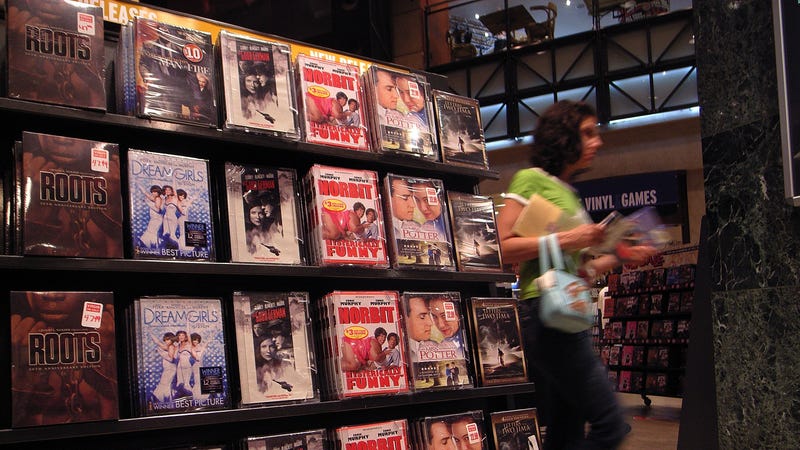
You Should Be Buying DVDs Instead Of Relying On Netflix

My personal collectionPhoto: Spencer Platt (Getty Images)

When you’re a kid, it’s perfectly fine to partake in an array of bizarre or grotesque behaviors. Whether you’ve decided to chop your own hair off, get married to a stuffed animal, or just to scribble nonsense all over the walls, you are set—this is the only time in your life when adults might even mistake those behaviors for being cute, even if they come at the expense of damaging the home you’ll inhabit for the early part of your life.

My toddler quirks didn’t tend towards property damage, but there was a time when I slept with VHS tapes. Not like in my bed, but in the years before I knew how to spell my own name I’d set my precious videos where books are supposed to go on the bedside table. There’s a story about my parents swiping the Toy Story tape out of its box while I was asleep, and me waking up late by toddler standards to discover it missing, then walking downstairs and finding them watching the movie. Physical media is important to me, and I believe it should never die.

I don’t have most of those VHS tapes anymore because they gave way to DVDs and Blu-rays, which may in turn give way to 4K technology. But for the moment, it’s hard to imagine a scenario in which I get rid of any of my discs or stop expanding my collection, even as physical media’s death rattle echoes louder. This is both because streaming culture sucks far worse than most of us would like to admit, and because DVDs are cooler than anyone remembers.

We’ve all found ourselves on either side of this sort of bleak interaction: “Have you seen Paddington 2?” “No, I’m waiting until it comes to Netflix.” “Sick.” (The first Paddington is currently streaming on Netflix, so get to it, you psycho.) Given that everything seems free or close to free, I can’t blame the impulse to wait everything out. With movies and TV shows coming and going from streaming services so often that there’s a cottage industry for “what’s new to/leaving Netflix” posts in the online content biz, your favorites are almost guaranteed to disappear at some point. And that’s not to mention Netflix’s piss-poor selection of films made before 1970—someday we’ll be as far removed from 1997 as we are from 1967, and Face/Off won’t be streaming.

Advertisement

My advice to you is this: just buy the movies you want to watch.

There’s really no good reason why DVD ownership isn’t in vogue in the same way that owning records is. (Maybe your dipshit college freshman roommate who insisted on calling them “films” and chronologically shelved his Criterion Collection ruined it for the rest of us?) On a practical level, DVDs are much easier to box up and move than vinyl, and you can even get one of those big leather-bound CD cases if the boxes are too much.

Advertisement

Streaming may seem more convenient, but that perspective vastly overlooks the benefits of DVDs: the boxes are fun as hell to open, and the gaudy menu screens can serve as a backdrop to some nervous, third-date post-movie makeout sessions. And there are bonus features! Commentary! I’m not saying anyone has time to explore every making-of featurette, but yes, I would like to hear a maybe-hammered Ben Affleck mercilessly roast his own movie, while watching said movie.

The best part might be that you don’t have to scroll through endless screens of middling content for something to watch if you already own, say, 50 of your favorites. You just walk over and put your selection into your DVD or Blu-ray player. (If you don’t have one of those, they now cost like $40.)

Advertisement

Streaming’s main appeal is convenience, but there’s nothing great about relying on Netflix to determine what movies you could and should watch on a given night. As streaming services shift further and further toward original content—Netflix intends to release somewhere in the neighborhood of 800 original creations this year—it’s a safe bet that they’ll feel less invested in the 30 Rocks and Godfathers of their catalogue.

There is something stable about physical media—not just because it can be held in your hands, but because your copy belongs to you. A streaming platform needs to churn and grow and add and add again, sometimes you just need to watch a movie that you like, and that’s much easier to do when it’s right there in your home. Just don’t let your rowdy kid smear peanut butter on the disc tray.

Holy Shit, Avengers: Infinity War Actually [Redacted] [Redacted] [Redacted]

Hey, have you seen Avengers: Infinity War? No? Stop reading, get the hell out of this post, leave your work early, get tickets, and then come right back here. Go, and go soon, because holy fucking shit, once people see this film this weekend there is no way you’re going to avoid spoilers.

S


P

O

I

L

E

R

SYOOOOOOOOOOOOOOOOOO!

YO!

They did it! They did The Snap!

Okay, okay, let’s back up. Just for a second. I know all anybody wants to talk about is the ending. I honestly was not sure whether we’d get the snap in this movie, or if this one would be the heroes briefly holding off the Mad Titan, but man, they really committed to it. Look at this list:

Gamora. Heimdall. Loki. Black Panther. Falcon. Vision. Bucky. Star-Lord. Mantis. Drax. Groot. Scarlet Witch. Dr. Strange. Spider-Man. 

Advertisement

They’re all dead. They’re gone.

“Mr. Stark, I don’t want to go.” 

Fucking stab me right in the heart and rip it out.

Let’s just run through the big moments, then we can comb through the finer things, because good lord, this film felt like nothing but big moments stacking on top of each other until the screen mercifully and frustratingly cut to black after that final dastardly content smile on the sunset.

Advertisement

From the moment the “Marvel Studios” logo disappears, one thing is made plain to viewers—this movie is not waiting for you to catch up, and it’s damn sure not going to do it for you. It opens after Xandar has already been decimated and the last of the Asgardians are being slaughtered. We’re introduced to Thanos, the film’s protagonist, in a way. He’s stunningly large, carrying Thor around like a sack of potatoes, and they show early on with a quick-but-devastating UFC match with Hulk that Thanos has the brawn to back up his high-minded talk.

This is just the first of many times Marvel shows off their high-tech motion-capture final product, and man, Thanos looks good. The subtle smirks, squints, smiles, strains, tears, all of it looks realistic, at least within the context of the MCU. Josh Brolin’s performance is pitch-perfect—if Thanos were just a raving genocidal meathead, the movie would crumble beneath its star power and nonstop narrative. But in a movie that clearly values every second, they allow Brolin quite a bit of room to introduce us to the inner-workings of a character that’s only ever been on the MCU’s periphery, through both flashbacks and some expository dialogue with Gamora and Dr. Strange. His home planet, Titan, was overpopulated and everybody except him died, and since then he’s been going around trying to wipe out half of the universe’s population. The Infinity Gauntlet and the Infinity Stones are the quickest route to that end goal. Over the course of the film, his motivations aren’t perfectly crafted to the point that you cheer for him, but they root themselves as believable enough in your mind early on, so that when he does the things he does in the latter half of the film, you feel at least part of the weight he feels when he makes some fairly dramatic decisions.

Advertisement

Back to the Asgardians: Loki and Heimdall are toast, as far as I’m concerned. My coworker Eric Van Allen pointed out that you can’t really have Thor movies without Loki, but for some reason, even though they allude to a hopeless revival a couple times, my feeling is that Loki is gone for good. (If that’s the case, this movie just wiped out essentially everything Thor: Ragnorak set up for Thor’s future story lines.)

The New York battle sequence with Iron Man, Wong, Spider-Man, and Dr. Strange is fast-paced, hilarious, and entertaining. And given that we’d just seen Loki snuffed out, the hindsight knowledge that everyone makes it out of this fight alive wasn’t quite as clear while everyone was getting their ass kicked. (We’ll come back to the Hulk’s low-T issues in a bit.) The most important thing the fight did was give us some much needed quality time with Ebony Maw, the clear standout among the Black Order. The Black Order seem to be Thanos’s top-four warriors, all with different strengths—Maw moves things, Proxima Midnight is a good fighter and can telekinetically control weapons, Black Dwarf is basically a dumb, scaly version of Hulk, and Corvus Glaive is Midnight’s boy, and he has a glaive.

Advertisement

It’s unclear just what the upper limits on Maw’s powers are—he splits a car in half, seamlessly controls metal objects, bests Dr. Strange pretty quickly—but he’s the only one among the Order that’s really given any sort of opportunity to voice his role, which is that of a devoted acolyte. He talks about how it’s “salvation” to be killed by Thanos; the other members of the Order just seem to really enjoy the killin’ part. (I’m sure there was a romantic goodbye scene between Proxima Midnight and Corvus Glaive that didn’t make the cut, but without it, Proxima and Black Dwarf are just bodies for the Avengers to punch and do slightly cooler Finishing Kills with than the six-armed aliens.) Maw’s build-up is short-lived, though, because he gets pretty easily disposed of on the spaceship back to Titan.

In Scotland, Scarlet Witch and Vision are chilling under the radar, thinking about running away together (like I said, this movie is not spending any time on the family farm) before one of the best jump-scares of the MCU, with Glaive stabbing Vision through the gut out of nowhere. This fight is honestly small beans compared to everything else, but it’s necessary to set up Vision’s tragic story, intro the Disgraced Avengers, and also get us to Wakanda.

Advertisement

The Guardians-Thor meet-up was a natural choice given the direction Taika Waititi took Ragnarok, and the humor here felt natural. The whole part about Star-Lord trying to establish male dominance in front of Gamora was cheesy, sure, but the two Chrises are good enough actors that it was fun for the brief moment it lasted. The Rocket-Thor pairing worked a lot better, if only because they both seem to possess a more grounded understanding of the reaches of power possible in the universe. Star-Lord, meanwhile, doesn’t seem to quite comprehend it, even joking around when Gamora begs him to kill her should Thanos get his hands on her. It takes her forcing him to swear on his dead mother to get him to finally stop deflecting and start accepting the gravity of the war they find themselves in. Of course, when he tries to do so, and saves his life by impressing Thanos, it doesn’t even matter thanks to that little red stone—that whole Collector fake-out sequence was amazing. Given that we’d already said farewell to Loki, I sincerely thought that was the end of Mantis and Drax.

The Thanos-Gamora setup is obviously what the writers and directors were banking on as one of the pillars holding up this movie. Only providing a single flashback asked a lot of us, as we had to then infer from Gamora constantly hurling insults at the big purple fella that their relationship deteriorated after he won five-year-old Gamora over with a shiny switchblade. But Zoe Saldana is, thankfully, a skilled enough actor to convey all the middle, unseen history between then and now—Thanos took her, killed her parents, made her his daughter and main assassin before she ran into a half-human named Peter Quill.

Advertisement

Cards on the table, I didn’t instantly remember how the Red Skull could have ended up on Vormir (he fell through a wormhole when he tried to hold the Space Stone in the first Captain America), but there he was. Some more cards on the table: I did not think that was when Gamora was going to die. I thought Gamora and the Soul Stone would be last, in terms of how and when Thanos figured out what the ultimate secret to obtaining the stone was. I had also convinced myself there was no way she would take Thanos to the one place the Soul Stone was, but then it kind of made sense when she tried to convince him that his path was doomed to failure because he didn’t love anybody. Given that she insisted on having Quill kill her, I have to think that final grasp on the ledge was an act, and that she realized too late that Thanos would indeed instantly realize that he did love her. But nope. It was as simple as that—Gamora, the most fierce, calculated, morally emboldened of the Guardians is no more. Barring a giant undoing of the entire movie’s events (certainly not unfathomable given what happened in this one), Gamora is gone.

The battle on Titan is split up over a series of cuts between the initial assault on Wakanda and Thor’s smithying side-mission. And here’s where the most frustrating part of the movie comes: When Star-Lord breaks down, refuses to believe Thanos, and then punches him, everyone in my theater groaned and gasped, because it is totally believable if you’re invested in Quill’s character. Over the course of the two Guardians films and his role in this movie, Quill often fails to comprehend matters outside of his immediate sphere; he’s riding high from realizing he’s part-Celestial and being a respected galaxy-guarder—even after Thor tells him Xandar is gone, he continues trying to one-up him. It is made quite clear that he has neither of the dread and anxiety of Iron Man or the pragmatism of Dr. Strange, and in this instance, it costs the half the universe their lives.

Advertisement

The first half of the battle on Wakanda is both very cool and very Avengers, which is to say we never really have a fear of either the Black Order or the aliens besting our heroes—by this point, we know they’re setting the table for the titan. There are plenty of great action shots, and even when the point predictably comes where the music takes a darker turn and the alien army seems to be overwhelming our heroes, the payoff of Thor coming through with his new Groot-Axe somehow still works, because that’s just what happens when you have Chris Hemsworth and an unlimited special effects budget. Both the Axe Throw and the Big Slam rule hard, and neither are top-5 moments in this movie.

No, the real fun comes after Dr. Strange turns over the Time Stone to save Tony Stark’s life—for a split-second, I was prepping for the end of Iron Man—and Thanos makes for Earth. That final walk, from the waterfall to the cliff’s edge where Vision was in a crumpled heap, is handled beautifully. By this point, we know none of the heroes in the frame have a chance. The closest thing to hope we get is Captain America surprising the towering monstrous villain by holding him back for a moment, and even then, it’s barely been two seconds before Thanos disposes of him with a screen-shaking right hook. Despite his Civil War activities, Vision is a completely sympathetic character this film, and it pays off when you watch Thanos smirk and simply rewind time and kill him, again, by plucking that stone, and a glob of wires and cables, from his forehead. And even then, you think that is the worst of it. When Thor finally appears and sends his axe several inches into Thanos’s chest, you think that this may be the end of the titan. But the camera lingers a moment too long—the first twinge of those purple lips was enough to signal what was coming, but by then your breath is gone. Then, Snap.

Advertisement

Everybody in the theater said something as each character floated away (Black Panther elicited the loudest cries) but for 30 seconds, everyone sat motionless and silent as Iron Man held Peter Parker in his arms, as the kid from Queens slowly drifted away. That moment, that one where Spider-Man fades—shit, I don’t think I quite have the words for it, even almost a full day later. I knew they were milking it, and damnit I still couldn’t stand to watch it. That’s how you do the damn Snap.

Here are my nitpicks and assorted thoughts:

  • The Black Order had no backstory, no motivations, and were basically just there to be people other than Thanos that our heroes could punch. Black Dwarf mumbles and grunts roughly three words; Proxima Midnight gets one line about how Black Widow stabbed her lover; and Corvus Glaive gets a good jump-scare and a couple decently frightening close-ups. That is largely it from this bunch, and while they make for some decent filler fighting, you can’t help but wonder if there wasn’t something more that could have been done here—then again, I’m not sure where you’d find the time to do so given this movie’s length and density.
  • I could have used a bit more time on pre-apocalypse Titan. Again, I’m not sure where we’d find the minutes for this, but I thought the single flashback to Titan with Dr. Strange sold short his commitment to this whole mission of population control. The Gamora flashback was quick, but the movie committed a powerful actress to convincing us that her experience with him was hell, in large part because it was a one-way relationship. The Titan-Thanos backstory only has Thanos to lean on, and while it’s still moving, maybe just one more convincing shot of Thanos pleading with his planet elders to hear him out may have made the mission more palatable. That it was as acceptable as it ended up being is a credit to Brolin and the CGI wizards.
  • Let’s talk about the banter, and this isn’t precisely a complaint. Infinity War is hands down the best in-theater experience Marvel’s put out. It’s grand, somber, insane, beautiful, and fun as hell. And a big part of that is because Marvel was able to handle each one of these characters so carefully and maintain the established tones and character quirks of each one. That’s naturally expressed via jokes and quips. So, if I have to shoehorn a very specific qualm in here, it’s that some jokes were too funny and made me and other people laugh a beat too long and miss a line. I will note that the Russos did a decent job of leaving laugh pauses, where we get a non-speaking shot of another character raising their eyebrows or laughing; I was just part of a particularly invested opening-night crowd, with one guy sitting near me that laughed at 100 percent full-volume for every fucking joke. Learn when to chuckle, my dude.
  • I’m not sure how people who aren’t at least halfway invested in the MCU will consume this film. It’s got numerous beautiful landscapes and set pieces, a couple excellent fight sequences, more than its fair share of truly emotional farewells, and pretty tight subplots that lead us to that magic moment. But so much of the emotional heft came from the baggage I carried into this movie, and I have a hard time understanding what these stakes would mean to someone who really didn’t care much about Captain America or Star-Lord or Gamora or Spider-Man as characters. As long as someone is a general superhero movie fan, I think it’ll still land, but hoo boy, as a 10-year fan, that final 30 minutes had my palms gushing sweat.
  • The “Iron Spider” suit and “Bleeding Edge” Iron Man suit both ruled very hard. I was curious how they were going to get nanotech from Wakanda into Stark’s hands, and they found a pretty slick way, melding together that info with the additional sting of realizing he’s ready to start a family and a life with Pepper Potts. Love the use of the extra spider legs and that we don’t have to spend any time exploring its new tricks.
  • Hulk has some stuff to figure out, it seems. After Thanos gives Hulk the ass-whooping of the lifetime (I half-expected Jim Ross to make a cameo when Thanos slammed him), Hulk is no longer interested in fighting, or even coming out to play, telling Bruce Banner “No!” multiple times. I’m not sure where this is building to for Avengers 4, since we’re not getting a Hulk cameo in either Ant-Man or Captain Marvel. All of our heroes have lost someone they care about by the end of the movie; for Banner, that just happens to be the big green beast that’s now hiding inside him, refusing to come out.
  • Hawkeye and Ant-Man are NOT in this movie! They’re under “house arrest,” according to Black Widow, who says they took a deal with the government after things died down from the Civil War debacle. So, expect Clint to show up on the family farm, either in Ant-Man & The Wasp or Avengers 4.

Advertisement

There are only a couple for-sure things moving forward:

  1. The Snap will go down as the single boldest decision Marvel’s committed to, narratively, in this entire 10-year run. Saying you are making a movie based on heavy source material is one thing in a reality where movies only get made if they can continue making you money—Captain America survived Civil War despite dying in the comic version. But to actually follow through with one of the most iconic comic book moments, that results in some of the most important (and yes, profitable) superheroes dying and not being resurrected in the same film, is a decision that’s earned, in part by having the source material as something to point to, and in part by making 18 preceding movies, of which the majority are fun and entertaining. Ending the movie with Thanos in a cabin on some random planet was a bold move that Marvel understood would not an acceptable cliffhanger if everything that preceded it didn’t earn it.
  2. Tony Stark is going to be fucked up. Part of Civil War and the entirety of Spiderman: Homecoming made very clear how Stark felt about using what is essentially a child soldier in this greater war he’s seen in both visions and dreams since he first fell back through the wormhole in 2012. Now, to have Spider-Man die in his arms, pleading with him like the child he is, just hours after he spoke to Pepper about wanting a child of their own, that’s it. That’s Stark’s worst nightmare in the fading flesh. I’m not sure what Avengers 4 holds for him, but expect to see a broken, unhinged Tony Stark hellbent on saving the universe and not himself.
  3. We’re absolutely still in the 1 in 14 million chance Dr. Strange told the team on Titan about. Everything from him telling Stark he’d risk “the kid’s life” and his life to protect the Stone, to his sudden willingness to turn over the Time Stone, to his parting message to Stark screams that The Snap was part of that larger plan.
  4. I have little idea what that larger plan is. All we have to go off of is the knowledge that Ant-Man & The Wasp is out in July and Captain Marvel is out next March—so, some combination of the quantum zone, the B.A.R.F technology, and Captain Marvel’s Kree connections will somehow lead us to beating Thanos. I’m sure those movies will fill in some gaps, but for once, I feel pretty clueless.

Advertisement

I’ve only watched every second of Avengers: Infinity War one time. My judgment is bound to change once I see it a second time and can pick it apart beat-by-beat; I’ll think of ideas of what the movie could have been, and formulate theories on how it could have better spent its time or built its characters. But for the first time, for the first full 2 hours and 40 minutes I spent starting at a massive screen watching what was basically three third acts, I couldn’t have been happier. It’s a cliché, but movies this daring and grand and beautiful are the reason people still go see them in theaters.

Advertisement

Infinity War’s floor is so high, that when you start to nitpick the film’s various pitfalls—Dinklage wasn’t really all that special; half of the Black Order were basically just walking punch machines; not enough time on pre-apocalypse Titan—you begin to realize just how impressive this film’s accomplishments are. This is a movie with 18 prequels and 30-some stars, none of whom feel cheated in terms of screen time, and more importantly, the quality of that screen time.

The main critique I’ve heard so far concerns the cliffhanger, but there’s just no way you could smash the collection of all the stones in half and still have a halfway decent film. The constant ramping up of the action and the stakes—Thanos threw a fucking moon at Iron Man!—and the commitment to the characters while not weakening the action or stakes made this movie’s ending absolutely perfect for me. For all that the MCU is (a movie-making, money-printing machine), if the trade-off for movies this fun requires that I have to go see another this summer and two more next year, then I’m all for it. “Thanos will return,” and I couldn’t be happier.

Advertisement

Avengers: Infinity War was a double-truck book fight come to life over the course of a full movie. It was colorful—no drab grey-blue palettes, here—it was well-acted, it was respectful of the source material, and it grounded itself in real stakes and balanced itself with a levity established in prior installments. It is a movie a younger me would have never expected to see made so perfectly, and it’s a movie even current-aged me could only halfway imagine.

As my girlfriend and I staggered out of the movie theater, shell-shocked and dazed from the most epic, wide-ranging, charging, heart-ripper of a MCU movie yet, we grasped for words to describe what we just saw. For whatever faults you have with the capitalistic film-making system or the marketing campaigns or the glut of superhero movies, all I can say is no other movie series has come close to making me feel that way. The day Marvel stops giving me that feeling, I’ll stop going. As best I can tell, based off Infinity War, that won’t be any time soon.

Deadpool Can Fuck Right Off

Illustration for article titled Deadpool Can Fuck Right OffPhoto: 20th Century Fox

The worst trend in modern moviegoing is not the proliferation or quality of superhero movies—there is just the right amount of those, and most of them are very good—but what happens to a theater when Stan Lee makes his way onscreen during one of these movies. I’d say around 2008, when the first Iron Man was released and the Marvel Cinematic Universe launched the first of what is now up to 19 installments, you would hear a few distinct chuckles as Lee showed up; it was a sort of audible nod, a nerd or two reveling in a payoff they’d come to expect. I know him, the sound told the crowd. By 2018, for the release of Black Panther and Avengers: Infinity War, just about the whole theater was emitting deep, forced, guttural laughs when Lee wandered onscreen. Almost everyone has caught onto pop culture’s biggest inside joke by now, and they very much want to make you aware of this fact.

Lee has now appeared in almost every one of Marvel’s film adaptations (33!), starting in earnest at the turn of the millennium with X-Men and Spider-Man, the two movies that set all of this into motion; his cameos go even further back than that, to the made-for-TV The Trial of the Incredible Hulk in 1989. Stan Lee’s prolonged involvement has always suggested that Marvel adaptations were unafraid to press against the fourth wall in obvious ways. Deadpool proved Marvel would take a bulldozer to it, and then pelt jagged chunks of the rubble at viewers until they’re rendered unconscious.

Advertisement

Before we go any further, here is a list of some things that aren’t objectionable on their own: the word fuck, extreme vulgarity, nudity, graphic violence in movies, DMX song placements, ostentatiously meta shit, Rob Delaney, and fun dumb summer blockbusters. Deadpool, and we can probably presume also its sequel, which is out Friday, contains some combination of those elements in no moderation. This is fine, I suppose—the movie will make truckloads of money and please a lot of people over the weekend, and there’s no law requiring you or me or anyone else to see it or care about it. But also, fuuuuuuck Deadpool. Fuck it right to hell.

Deadpool sucks as badly as it does, which is extremely badly, for reasons that are both in and outside of its control. I’m told it’s faithful to the source material, which is something I don’t really care about when trying to enjoy any movie on its own terms. Ryan Reynolds, who’s always seemed like a relatively smug and self-satisfied guy, has finally brought his passion project to the screen. It was all sort of preordained, after Deadpool declared that he looked like Reynolds crossed with a Shar-Pei in an issue of the comic book. The struggle to bring Deadpool to theaters is well-documented and spanned nearly 16 years, and as such the goalposts were generously placed once the movie actually became a living breathing work. That it existed at all was, for people invested in it, a triumph in its own right.

Advertisement

That fundamental laziness—the smug certitude that simply Recognizably Being A Thing is enough—fits Deadpool’s style of comedy nicely. The Deadpool comedic approach is, in its way, the logical conclusion of all those Stan Lee cameos—a joke that isn’t really a joke so much as it is just Recognizably Being A Thing. That’s not the only obvious influence on the Deadpool style, of course—you’ve got a little bit of shitty Harambe meme vibes, some GEICO commercial moves, and to a lesser degree, a bite of the broader approach in Guardians of the Galaxy. All of the above offer a post-punchline approach to jokes, one that places far greater emphasis on the joke existing rather than its execution, delivery, or writing. They just kind of rapidly sputter out like nervous tics, and often at the expense of boring features like narrative coherence or rhythm. It doesn’t matter how Deadpool acknowledges Reynolds’ stint in the megaflop Green Lantern, the first movie’s relatively shoestring budget, that it only could afford D-list X-Men to aid his efforts, or how X-Men Origins: Wolverine mangled the character as long as all that is in there, and preferably sold with a cute enough wink to satisfy anyone who’s simply keeping up.

Everyone involved seems extremely proud of what they can get away with—look no further than Deadpool 2's original score, which giddily became the first film score to earn a Parental Advisory “badge of honor” on the back of song titles like “Holy Shit Balls” and “You Can’t Stop This Motherfucker.” For comic invention, the whole enterprise doesn’t amount to much more than a middle school chud who’s finally allowed to watch some R-movies and shouts the word “penis” at increasingly loud volumes in the cafeteria.

Advertisement

There is something appealing about a movie being able to own its studio and nearly everyone involved in making it, which Deadpool did pull off by way of its mildly amusing opening credits. It’s a minor achievement, since the studio will take no issue in fielding these barbs so long as the Deadpool franchise continues to rake in something like $800 million at the worldwide box office. I can also understand why Deadpool might have felt so refreshing in 2016, contrasted as it was with the gruff and tragically constipated DC heroes and the MCU’s general vibe of “enjoying a cold one with the boys while the entire universe hangs in the balance.” The stakes in the first Deadpool were admirably personal, even if director Tim Miller let the set pieces get away from him near the end.

Perhaps the best side effect of Deadpool, if there’s one to be had, is how it eased Marvel properties and thereby every other tentpole into embracing the R-rating. It’s not like this was revolutionary, really—The Matrix and 300 proved this to be possible in each of the last two decades—but it likely helped convince 20th Century Fox to take a chance on an R-rated Logan. Maybe someday Marvel will greenlight a more subversive gore-fest like Matthew Vaughn’s grimy, under-appreciated Kick Ass, which was slightly less impressed with itself than Deadpool.

Advertisement

Of course there were concerns that Disney’s acquisition of 20th Century Fox might water down Deadpool for future installments, or force his integration into the Avengers universe, which is my true nightmare. But there’s nothing about the character, who is still as corny as a career theme park employee, that suggests he won’t be right at home in the Mouse House. He won’t have to dilute anything, which is probably for the best, since we’d just get an onslaught of jokes about why he can’t get the swears off. That’s the thrill of it all. The noticing.

Who Is The Most Adam Sandler Director?

Abbie DoobieIllustration: Elena Scotti

Most friendships have a sort of intrinsic half-life. Each passing year tends to draw you further from the people you care about or at least reduce the number of people you stay in touch with, but this is usually a good thing. I’d say the best number of friends is somewhere around MySpace’s platonic ideal of a top eight—just enough to keep up with to a point that isn’t overwhelming, with ample time left for your family or significant other. At 24, I’m not quite there yet, but have seen this number naturally erode over the years by way of geographic separation or mutual indifference; there is an essential core that is not going anywhere, and then there are those biannual check-ins that fall into the margins. This is how it works.

No one has applied this law of diminishing friendships to their professional life quite like Adam Sandler. There are those obvious pairings—longtime accomplices like Rob Schneider, Kevin James, Steve Buscemi, Henry Winkler, Nick Swardson, and so on—but Sandler has worked with just three directors for a large segment of his career, give or take the odd fling with Paul Thomas Anderson or Noah Baumbach. You probably haven’t heard their names before.

Dennis Dugan, Steven Brill, and Frank Coraci are three otherwise obscure filmmakers who have combined to direct 17 more or less interchangeable Sandler joints and, within those films, an unknown and quite possibly inexpressible number of farts. I like to imagine the three holding a sort of private auction every time a new script comes in and divvying up the films in a way that seems fair to all parties. It isn’t necessarily a unique or novel thing for directors to build up a stable of dependable actors for each new movie—Wes Anderson doesn’t seem to have added many names to his meticulously preserved antique Rolodex since like 2004—and yet it seldom runs the other way. Sandler has a stable of directors all his own, and he clearly believes in them.

Dennis Dugan, Steven Brill, and Frank Coraci have combined to direct 17 more or less interchangeable Sandler joints and, within those films, an unknown and quite possibly inexpressible number of farts.

Advertisement

This is probably a good time to mention that Sandler is a skilled actor, and one who could eventually enjoy a McConaughssaince-grade reappraisal; Sandler’s next project is the Safdie brothers’ follow-up to Good Time, which really is the most ambitious crossover event in history. When Sandler works with a talented director who can harness his talents, the results are inarguable—he has the range. But his filmography is a testament to the fact that he’d sometimes rather kind of mumble some joke about butts while blearily lounging on the beach. Most actors of Sandler’s generation would be happy to trade their professional peaks or bank accounts with Sandler. It’s the stuff in the middle—the films that are mostly the work of Dugan, Coraci, and Brill—that can be a little more spotty.

It would be not just unfair but delusional to say that the DuCorBri trifecta has not coaxed a few legendary—or, anyway, profoundly capable performances—out of Sandler. Dugan has Happy Gilmore and I guess also You Don’t Mess With the Zohan under his belt; Brill at least has the Foot Scene from Mr. Deeds; Coraci can claim The Wedding Singer. There’s really nothing that quite distinguishes one director’s style from another—Coraci tends to wear a lot of fedoras and various blobs of facial hair, but that’s a whole separate conversation. All three are best pals with Sandler, who has entrusted them to guide his career from those first breakout hits in the mid-’90s through the end of his lucrative Netflix contract.

Advertisement

Sandler is the center of his own universe, the rare actor who seems more in control of his creative output than any director or studio head. He tends to make all involved bend to his impulses, for better or worse. The preponderance of filmed evidence suggests that Sandler is doing more or less the work he wants to do, but those outliers suggest he’s capable of more. What Sandler will do once he gets out of his deal with the streaming titan is anyone’s guess. But to understand where Adam Sandler might go from here, it makes sense to look back at the three men who’ve shaped him, or let Sandler shape them, or just shared his taste in fart jokes. It’s time to dive into the DuCorBri canon.

To help with this work, I contacted Eloy Lugo, a music publicist for Grandstand Media by day and Adam Sandler aficionado by night and honestly also probably also by day. Lugo is perhaps our greatest living authority on this topic, a man who of his own volition leveled up from an annual 24-hour SandlerCon marathon to a full-on yearlong endurance test that he called the Year of Sandler. In honor of the thespian’s 51st birthday, Lugo is watching a Sandler movie every day for an entire year, repeats and all. When we last talked he was 100 days and maybe six more Jack and Jill viewings from the end of that task.

Advertisement

This work has afforded Lugo plenty of time for noticing the dubiously graceful grace notes that Sandler includes across his canon—things like squeezing a “that’s my boy!” into almost every movie, including 2012's That’s My Boy, but also the weird multiverse of recurring characters and referential strands running throughout each of Sandler’s movies. A task like this would sound masochistic no matter the actor in question, but when that performer is Sandler it looks like a true labor of love. “I’ve always had a ton of genuine non-ironic love for Sandler, he’s a fearless and incredibly gifted performer,” Lugo told me. “He’s been a constant in my life since I was a child, through SNL, his albums, and movies. His work ethic is unrivaled, he’s made a minimum of one movie a year since 1998. He was in four movies in 2014 alone.”

And so, with guidance from Eloy and my own familiarity with the Sandler vault, I got to work. The goal was to assess not just the Sandler ouevre but the DuCorBri canon in particular. The first step in doing this was coming up with five quantifiable, mathematically objective categories to determine which of the Big Three directors are the Most Extremely Sandler.

Advertisement

Sandler Ratio (SNR): This is the most straightforward metric of measuring a filmmaker’s commitment to Sandler. You take the total number of films in their filmography in which Sandler is in a lead role and then divide it by the total number of feature films in the filmography. Then you’ve arrived at their SNR.

Vacationability Index (VCI): Adam Sandler likes to travel, friends, and he is willing to make an entire feature film if it gets him a chance to visit Hawaii. The VCI chooses one movie from each director at random, and calculates the distance principal photography took place from Sandler’s home in Los Angeles. To take one (representative) example, Just Go With It was largely filmed in Maui—2,494 miles away from L.A.

Advertisement

Award Season Coefficient (ASC): While I maintain that Sandler will be nominated and perhaps even win an Academy Award at some point in the next 20 years—he was probably owed something last year for Noah Baumbach’s The Meyerowitz Stories—the trifecta are not how he’s going to get there. Instead, we’ll look at some more likely places of recognition. Your ASC will take the number of Golden Raspberry nominations multiplied by the number of Kids Choice Award nominations earned by each director’s films.

Sports Proximity Sum (SPS): Adam Sandler loves his sports. He’s made four movies explicitly about sports—Happy Gilmore, The Longest Yard, The Waterboy—and is never shy about recruiting sports personalities, ranging from Shaq to Dan Patrick and John McEnroe, to appear in his films in some capacity. Tally the roles of notable sports personages in each director’s film and you’ve got your SPS.

Advertisement

Dave Matthews Butt Coconuts (DMBC): Has the director filmed a scene in which Dave Matthews, jam-band impresario and Lady Bird-soundtracker, picks up a coconut with his ass? Add 69 points to the director’s score if so; subtract 69 points if this does not apply.

To arrive at the final score, each director’s results from each category were run through the following formula: SNR x VCI/SNF + ASC + SPS + DMBC. Dugan, Brill, and Coraci were then ranked from lowest to highest score. I don’t make the rules. Here we go:

Advertisement

3. Frank Coraci

SNR: .55 (5/9 films with Sandler)

VCI: 848 miles, The Ridiculous 6

ASC: 0 (2 Razzie, 0 Kids Choice)

SPS: 4

DMBC: -69

Total Score: 29.21

There are those viral tweets you see every few months that let easily amused online people generate Their Rap Names by quote tweeting with “Yung” plus their favorite marsupial/mother’s maiden name/social security number. The aliases are mostly gibberish, but there is such a thing as an intuitive, objectively correct alias. This is relevant because Frank Coraci tends to go by variations of either FrankoSpanko or Spanknyce in his online life; he uses some version of the former in his Twitter handle and DJ name, and named his production company after the latter.

Advertisement

And yet, this same man is also responsible for Sandler’s closest thing to an effective melodrama. That’s Click, a movie I remembered fairly fondly on first viewing but which ended up being a little more jarring in its tonal shifts on a rewatch, is a solid enough gloss on It’s A Wonderful Life—a version of a classic American fable made for suburbanites who spend a lot of time at Bed, Bath, and Beyond. There’s nothing distinctly Coracian about Click, it should be said. He seems, as a filmmaker, to have a slightly mushier interior than his contemporaries but this...does not come through in all of his movies. For instance, he also directed the idiotic and pretty racist The Ridiculous 6. But he also directed Click, which Mick “Click” LaSalle of the San Francisco Chronicle hailed as “one of the best American films of the year” upon release. Frank Coraci’s filmography is truly a land of contrasts.

Sandler and Coraci are certainly ideal professional bedfellows, and they’ve worked together in three different decades now. But Coraci’s slightly lower output and disappointing vacationability keeps him at no. 3.

Advertisement

2. Steven Brill

SNR: .5 (4/8 films with Sandler)

VCI: 2,422 miles, The Do-Over

ASC: 2 (2 Razzie, 1 Kids Choice)

SPS: 2

DMBC: -69

Total Score: 237.75

Diminishing friendships make you appreciate the ones that endure even more. Brill and Sandler went a whopping 14 years between collaborations—Brill was busy with some Sandler-adjacent projects, like Without a Paddle and Drillbit Taylor in the interim. But Sandler’s gargantuan multi-picture Netflix deal brought these titans back together for the doubleheader of The Do-Over and Sandy Wexler.

Advertisement

This is honestly a fairly low bar, but Brill might be the filmmaker you’re likeliest to recognize for his work outside the Sandlerverse, which includes directing Heavy Weights, writing The Mighty Ducks, and appearing as an actor in films like Sex, Lies, and Videotape, Knocked Up, and Batman Returns (he was a revelation as Gothamite #1). But you don’t get a Sandler Score of 237.75 just from cozying up to Judd Apatow or Steven Soderbergh—this is about The Sandler, and Brill is about that, too.

While Brill has the longest gap without A Sandler of any of the DuCorBri triumvirate, his early involvement is enough to last a lifetime: before he returned to the fold during The Netflix Years, Brill directed Little Nicky and Mr. Deeds and helped with the screenplays of The Wedding Singer and Big Daddy. I will not speculate that their 14 years apart suggests some grand falling out beyond what tends happens to men of a certain age, or the natural attrition that is built into every adult friendship. What’s most important is that Brill is back.

Advertisement

He’s all the way back, in fact, like to the point where he recorded a video message for this year’s SandlerCon:

Advertisement

1. Dennis Dugan

SNR: .57 (8/14 films with Sandler)

VCI: 2,494 miles, Just Go With It

ASC: 36 (18 Razzie, 2 Kids Choice)

SPS: 9

DMBC: 69

Total Score: 291.70

Did you really think this could be anyone else? Even if you are not as up on the DuCorBri experience, it should have been obvious that Dugan’s the one. I could talk about his track record, which is highlighted by him directing more Sandler films (eight) than any other director. I could talk about him directing The Benchwarmers mere years before his son Kelly Dugan became the Phillies’ second-round draft pick in 2009. (Kelly appears to be out of organized baseball this year, but made it as far as Triple-A in 2015.)

Advertisement

I could talk about David Spade shooting a fountain of vomit out of a tire in Shaq’s general direction in Grown-Ups, which is as purely Dugan-ian film vision as any imaginable. I could talk about Dave Matthews’ prescient turn as a white supremacist lunk in You Don’t Mess With the Zohan. I could talk about The Dunkaccino musical number, a simultaneous high and low point in Al Pacino’s strange late career. I should probably mention, as Eloy recently pointed out after watching the movie 15 times in the past nine months, that Dugan filmed and released an entirely different version of Jack and Jill for release in Spain, which featured a character and storyline that was not in the U.S. version. “I don’t think I know of another movie that has an additional character and storyline for a different territory,” he says. (Me neither.)

But nothing really distills the Dugan essence, the Sandler essence, the friend essence, quite like this quote that’s been attributed to the director:

“Audiences that go to my movies don’t want a message. They don’t want my soul exposed or my life view. They just want to laugh.”

Advertisement

Sometimes that’s the best kind of friend you could want. The kind of friend you’re most likely to keep around. Sometimes you just want to laugh. Also Dugan is the filmmaker responsible for the Dave Matthews Butt Coconut moment, so this was never really going to be that close.

Bull Durham's Annie Savoy Is The Patron Saint Of Female Baseball Fans

Illustration for article titled Bull Durham's Annie Savoy Is The Patron Saint Of Female Baseball FansIllustration: Elena Scotti (GMG), Photo: 20th Century Fox/Shutterstock

I believe in the Church of Baseball. I was raised in it after all, taken to a stadium with plastic seats that got so hot they’d roast the back of my thighs while the tops of them burned. I learned the liturgy and the scriptures and the seventh-inning hymns. The smell of dirt and fresh-cut grass became my incense and the hot dog my holy wafer. The Church of Baseball has many members, plenty of leaders who draw crowds and convert nonbelievers. But I have always been a disciple of Annie Savoy.

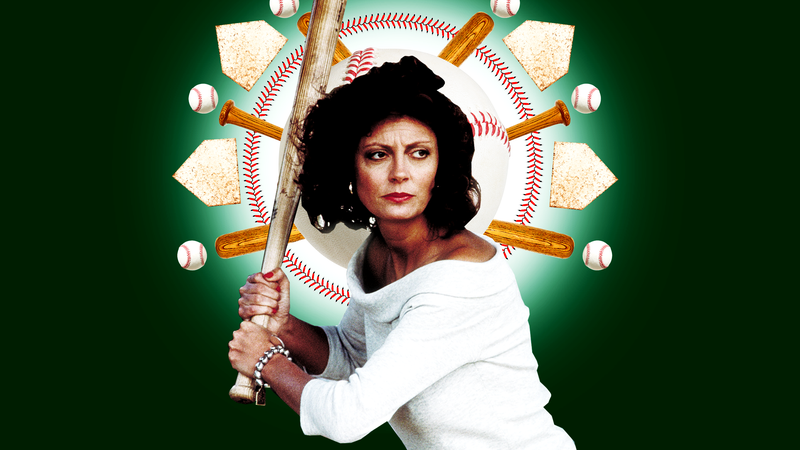
“I prefer metaphysics to theology. You see, there’s no guilt in baseball, and it’s never boring,” Annie Savoy says. It’s a line that could come out of any fan’s mouth except that she follows it up with “... which makes it like sex. There’s never been a player slept with me who didn’t have the best year of his career.” Annie Savoy, played by Susan Sarandon in the 1988 classic baseball movie Bull Durham, is the best representation of female fandom in any sport—not because, mind you, she sleeps with players, but because she has a deep knowledge of and undeniable love for the game. There are, of course, plenty of women who worship in the Church of Baseball. But all too often, we are ignored in popular representations of the sport.

The wallpaper in Annie’s home is light pink, baby blue, and adorned with flowers. Her mint green Victorian home in North Carolina has a wraparound porch, white shutters, and a white fence. But its best selling point is that it’s walking distance from the minor-league baseball stadium. Annie Savoy has a vanity with three mirrors, a bed with a full frame, a bottle of perfume she uses to douse herself on each side of the neck and between her breasts. In another room, she has a separate shrine, adorned with a few mitts, a couple of balls, a half dozen candles, and a player piano, devoted to the Church of Baseball.

Bull Durham came out 30 years ago this week, four years before A League of Their Own, before the popular imagination remembered that women have played and do play and love baseball. Very few women play baseball professionally in America (though some do), but every team has a choir of Annie Savoys, women who love the game deeply, wholeheartedly, and who do not fit into any single stereotype of female fandom—who are not there only out of lust, or to please a boyfriend, or as just casual viewers.

Advertisement

In the movie, Annie Savoy attends games in an A-line full skirt with a waist ribbon, a silver brooch, and heels. Throughout the Durham Bulls’ fairly terrible season, she’s pictured wearing a a boatneck shirt, a cashmere sweater, a hat with a veil, an oversized blazer. She’s feminine, Southern, and a damn good fan. At games, she sits with a box score, a glove, a notebook filled with her tight, curly handwriting, binoculars, and a radar gun. When players do stupid things like pull their hips, she hastily sends a note down to the dugout.

Bull Durham is a romantic comedy set in a baseball stadium. It is a movie as much about sex and love and relationships as it is about the diamond. But Annie is not reduced to her decision to pick out on player every season to sleep with, or her obvious attraction to many of the players. This is a key mindset of the movie from the very beginning, when Annie’s best friend Millie is caught having sex with the new starting pitcher in the clubhouse and refuses to be called a “piece of ass.” The two are heterosexual (ostensibly) and openly attracted to and sleeping with players. But the movie takes great strides to present them as fans as well.

Advertisement

Illustration for article titled Bull Durham's Annie Savoy Is The Patron Saint Of Female Baseball FansPhoto: Orion Pictures

In the stands they discuss pitch speed and batting stance, they take rigorous notes. In one scene, in the backyard, Millie plays catcher in an impromptu throwing session for the young, inexperienced pitcher Nuke LaLoosh. The movie may be 30 years old, but this idea is still revolutionary: that women can be fans of the sport as deeply as obsessively as men, despite (or without) any attraction to their favorite players.

Advertisement

I am a Washington Nationals fan. I go to the games. I keep boxscores. I know which of our outfielders cannot take a good line to the ball to save his life (Andrew Stevenson) and who gets lost in his head the most (Trea Turner). Do I love Bryce Harper for his beautiful head of hair? Absolutely. But I love him more for the slight adjustment he made to his swing this spring, limiting his kick out to gain power through the zone. Do I smile every time Anthony Rendon throws a wink at a teammate? Can’t help it! But I smile bigger if he makes a snags a cut up the line on his backhand and whips it to first in time for the out. Sure, the #Thirstbaseman hashtag is fun. But you know what’s more fun? Winning. I guess it’s too bad I’m a Nationals fan, then.

Last season, I went to a game in high summer. This swamp of a city had triple-digit temperatures, and when my husband took a break from the heat to go to the bathroom, I was left alone in the stands for no longer than 15 minutes. That was all it took, a woman alone with a boxscore in the stands even momentarily, to be demeaned. “I wish my girlfriend would come to the game with me,” the man next to me said, trying to congratulate me on being able to sit through a whole game. “Actually, he’s here with me,” I said. My husband appreciates the game, has learned to enjoy it, but I converted him. I am the one who knows the nuances, the strangeness of this overly complicated sport.

Advertisement

There are always unbelievers in a stadium, but not all of them are women.

At one game, I sat in front of a crew of men pretending to know what they were talking about. “Scherzer’s great and all,” one of them said to his friend referring to our three-time Cy Young winner, “but I just can’t respect a pitcher with only two pitches.” Inadvertently, I laughed. Max Scherzer has five solid pitches: a four-seam fastball, a changeup, a cutter, a curveball, and a slider. “Something funny, sweetheart?” he asked. It had been rude of me to laugh, but now engaged, I told him why. His friends laughed at him, made fun of him for being shown up by me, a woman.

Advertisement

I could tell dozens of these stories: about men who have relentlessly hit on me because I keep a boxscore, about men who have brushed off my opinions about the team at parties, about fellow fans who have treated me as a tourist in their home country, someone who doesn’t belong. Of course, there are exceptions. But they are exceptions, not the rule.

Major League Baseball does a terrible job of acknowledging and appreciating its female fans. All of the “women’s cut” gear is form-fitting, much of it is pink. “At all stages in history, women have had to fight for their place in baseball,” Mary Craig wrote in an excellent history of MLB’s failure to accept female fans. “The only time they are taken seriously is when economic necessity dictates it, and they are immediately discarded as soon as doing so is not detrimental to the sport or the teams.”

Advertisement

Craig makes her point most convincingly in her history of “Ladies’ Night” promotions, which have been happening in the National League since 1888. It’s a controversial promotion mainly because having control over spaces of entertainment is a particular kind of power that allows you to behave however you want, that men are extremely unwilling to relinquish in sports arenas. In the ’70s, male fans became so upset over Ladies’ Nights that they filed a gender discrimination suit against them. The men in this suit were the ones being discriminated against. (Still, during locally broadcast Nationals games, there are advertisements for “Ladies Nights.”)

In popular lore, male fans of the 1960s wanted women dismissed from the fandom so badly they made up a historical riot. They claimed that in 1897, a slew of female fans for the Washington Senators had charged the field and attacked an umpire in a mob after a heartthrob pitcher was thrown from the game. Reports of women “tearing up seats and breaking windows” over this “handsome young pitcher” appear in books about baseball history and dozens of articles.

Advertisement

Darlene Langley of FanSided did an in-depth research piece on the riots in 2015. She found that there was no record of a mob charging the field, that windows could not have been broken because the Senators stadium at the time did not have any, and that only one Washington newspaper (of three) even reported any kind of upset on Ladies Night that year. What actually happened is that an umpire made a controversial call in the seventh inning, and after the game, they screamed at the umpire for his mistake (allegedly, one woman even hit him). This is obviously objectively bad behavior and sportsmanship, but it is also what passionate fans do. All fans scream at umpires. The twist that made this lore demeaning to women wasn’t that they rioted, but that they did so over handsome sweetheart rather than a bad call that went against their team.

In Bull Durham, even though Annie Savoy sleeps with plenty of baseball players, and attraction plays a large role in her consumption of the sport, she also has nuanced, articulate opinions about the game and how it should be played. She adjusts the new pitcher’s form, gets him out of his own head. Her attraction to him does not diminish or increase her obsession with the game.

Advertisement

Women are baseball fans, and serious ones, and have been for longer than MLB has existed. As early as 1901, the Washington Sunday Herald pointed out that, “It is now fashionable for ladies to make up a party and go without the usual male escort.” Sister Francis Evans attended Texas Rangers games for more than 30 years before she died last summer. She brought her drum to every game to lead cheers and when she died, the ballclub released a statement of adoration and appreciation. She is not an aberration, and she certainly wasn’t interested in the game only because she was horny for players. There are long lines for women’s bathrooms at games for reasons of numbers. For every woman there on a date, there is a man unwillingly there for a corporate event. There are always unbelievers in a stadium, but not all of them are women.

But Annie Savoy represents an ideal world, the one I want to live in: one that a woman’s opinions on baseball are taken seriously enough to be fought with, and to be considered seriously. One where you don’t have to wear, or say, or abide by a certain stereotype to be taken seriously, where just loving the game is enough. Early in the movie, the veteran Crash Davis gets a note from Annie, and the assistant manager (whose job she could easily do) backs up her knowledge of the game. She’s respected by the players and fans alike because she is a fan. That’s what should matter in the stands of any sport: not that fans be or act a certain way, but that they care and love the game. All should be welcome in the Church of Baseball.

Advertisement

Kelsey McKinney is a writer living in Washington, D.C. You can follow her on Twitter here.

Hereditary Will Completely Fuck Up Even The Most Seasoned Horror-Movie Watcher

My favorite genre of fiction, in books and stories and movies and probably even television shows, is horror. I love horror. I watch horror movies all the time. I stay up late after my wife goes to bed so that I can watch more horror movies, even though it means that I sleep terribly. My worry with Hereditary was that it’d be a punishment reel, a clumsy metaphor, or a vaguely-horror-ish but mostly grueling and tense tale of family trauma. That was not the case. It is horror. Whatever else it might also be, it is for sure a horror movie, and it’s the most terrifying horror movie I’ve ever watched.

I saw it Tuesday in an empty theater, and my brain is now a rattled mess. My hands were shaking on the walk to the car after it was over, and at several points during the last third of the movie I had to stop myself from sprinting out of the theater. I’ll try hard not to spoil anything, but know that this movie deploys every good horror trick in the book, with ruthless, relentless glee, all the way to the very end.

Advertisement

All stories come from somewhere, but a story told especially well obliterates all its origins and symbols behind the sheer thrill of exploring its plot points. If you’re telling a story around a campfire and your listeners have the bandwidth to wonder what is he really talking about right now, you are a bad storyteller. Horror movies can also be about Big Ideas, but most of the very good ones—The Shining, Rosemary’s Baby, The Exorcist, The Witch—are so good at telling their linear stories of things happening that you don’t necessarily need to trouble yourself with whatever Big Ideas might be there for the assembling. The Witch ripped my dick off—if someone came along later and told me actually The Witch is about the puritanical lineage of our ongoing oppression of pubescent female sexuality I’d be like huh, hey, remember when the old witch lady ate the fucking goat? She made a baby into chunky red butter and an evil goat killed a guy, and sorry that was a little distracting, you know?

I bring that up because Hereditary is so insanely frightening, so overwhelmingly terrifying, that there is no space left in my brain to even come up with a funny fake headline for a pretentious think piece about its symbolism. Some of what Hereditary is about is baggage and the destructive force of inherited trauma, but the plot is tight and propulsive enough, and the dread is so palpable, that it preempted and resisted and obliterated in realtime whatever feeble attempts I might’ve made to retreat to the calmer headspace of cohering its themes into some Important Observation About Families or Motherhood or Nature Versus Nurture or even Undiagnosed Psychological Disorders. The Babadook, by way of comparison, is a fine and frightening movie, but if you found its themes and emotional framework a little too front and center, you will have no such issues with Hereditary. It presents complex emotional circumstances, and there’s plenty of psychology to mine, but first and foremost it is very much about fucked-up, frightening things happening, like any good campfire yarn.

Advertisement

Hereditary does traffic in extreme horror, here and there, but those moments are mostly punctuation points amid exquisitely rendered sequences of almost unbearable terror. It’s helpful to think of it this way: horror is seeing; terror is not wanting to see. When Hereditary isn’t showing something horrifying, it’s slow-burning an atmosphere of escalating dread, using a bag of tricks so familiar to horror-film aficionados that it would be charming if it weren’t so cruelly effective. You’ll have no trouble spotting the influence of The Shining and Rosemary’s Baby. The way it trains the viewer via clever timing and framing to search every inch of the screen at all times will be familiar to anyone who enjoys the Insidious brand of mildly cheesy, meticulously constructed, undeniably formulaic supernatural horror.

But where Insidious and The Conjuring and their various sequels and offshoots are sort of thrill-a-minute popcorn flicks whose scares play out like darkly lit practical jokes, Hereditary is a genuinely upsetting story that, like The Witch, depicts explicit, unimaginable traumas that cannot be reversed. Toni Collette plays the emotional core of a family coming apart in spectacular fashion, under siege by forces well beyond their combined powers to even identify, let alone resist. The characters’ psychology is also a carefully manipulated variable, and the effect is a movie that keeps you guessing along the way just how much of what you’re seeing might be imagined. Those James Wan flicks keep their fundamental breeziness by more or less keeping the families intact, and utilizing those families’ simple virtues and some hope for a return to normalcy as a buoy amid all that dread. Hell, even The Shining and The Exorcist offer a kind of compromised relief at the end—at least there are innocents, and they can be spared. The family in Hereditary is fracturing and straining under old pressures and buried traumas before the real shit even hits the fan, and when things finally do go sideways the pivot is so nightmarishly explicit and brutal as to obliterate any hope that the situation is salvageable.

Advertisement

While that’s all awful enough all on its own, there’s also the ominous and increasingly undeniable suggestion of malevolent supernatural forces to sow distrust between the characters, and also between the story and the audience. In a weird way, the possibility that the events on screen were being manipulated and conjured by actual demonic forces wound up providing a kind of emotional anchor: I can’t save these people, but I can at least hope that all this hellish misery really is beyond their control. In a way it preserved for them the possibility of a kind of redemption, or salvation. That, ultimately, was less a theme of the movie than it was a lifeline for my sanity—it’s amazing how frayed my nerves were as the movie lingered on faces filled with terror and silhouettes lurking in darkened corners.

The story of this family’s grueling and violent dissolution, after every story of more mundane, reality-based family dissolution has already been told several times over, would be an exercise in thankless punishment without a compelling anchor in the supernatural to make it interesting. In Hereditary, the supernatural is deployed carefully but explicitly, among other things girding the movie against any frustration I might’ve otherwise felt towards the erratic, troubling developments of the family members’ individual story arcs. Yes, they often behave irrationally and destructively, but it is also evident that they might be up against something alien and profoundly indifferent to their suffering, and their various failings never come close to violating or disrupting those terms. Collette is brilliant and terrifying as a woman with a powerfully fucked-up psyche, and Gabriel Byrne is terrific as a grounded husband struggling to provide a stabilizing presence in an increasingly volatile household, but even without those nuanced performances the movie presents the possibility of actual fucking demons as a backdrop for every explosive exchange.

Advertisement

As I mentioned, classics like The Exorcist and The Shining allow the viewer to exhale some of the accumulated angst before the end of the movie. That’s very much not the case here. Hereditary ratchets up the horror all the way to its indescribably strange ending. When the credits rolled, the relief I felt wasn’t in how the movie ended, but rather that I had survived long enough to exit the theater, whereupon I immediately called my wife for emotional support. But it’s also true that the ending, which is perhaps the darkest and most insane sequence of the whole cursed movie, is also the story’s most exhilarating moment. It has that trait vaguely in common with some of its genre progenitors, but to name them would be to rub right up against spoiling Hereditary’s bananas ending. Suffice to say, the movie is skilled enough in its storytelling to keep the viewer always unsure of the reliability of whatever perspective is being depicted, and though that delicate touch isn’t necessarily abandoned in the ending sequence—what qualifies as a conclusion to the film’s bonkers narrative arc—it is so tangible and specific and specifically horrifying as to render any question of its meaning superfluous. All I know is what I saw, but I know what the hell I saw! It was almost more than my shredded brain could handle, just an explosion of madness and depravity and balls-out horror, as far beyond my capacity for sober comprehension as Cthulhu marching through my backyard. There isn’t enough bandwidth in the universe to make more of it than that.

Movie Talkers Are So Much Worse Than Movie Texters

Illustration for article titled Movie Talkers Are So Much Worse Than Movie Texters

The holidays are about consuming copious amounts of food and finding things to do with your family that allow you to be with them while also ignoring them. My family’s method of choice is watching movies. And so this past Christmas, we gathered round to watch a pair of holiday classics—Michael Clayton and uh Dunkirk—on consecutive nights. My aunt and uncle suggested the former, I the latter—not necessarily because I thought it was a masterpiece or anything, just that it seemed close enough to a traditional war movie that might also be potent enough to let everyone sit in silence for a few seconds after the credits hit before saying, “that was powerful.”

Michael Clayton went well enough, which is to say everyone was mostly into it. It’s a fantastic movie, so that’s no surprise; Clooney is somehow still an actor I tend to underrate, despite his Oscar and name and timeless genre-defining performance in Batman and Robin. It had a perfect ending, too. There was one hiccup, though, maybe 20 minutes into the movie. That was when I had the audacity to check my lock screen during a lull. My uncle picked up on this, insisted that some important plot development had ensued, and that we should rewind so everyone was up to speed, despite my missing maybe a line of dialogue.

Dunkirk enjoyed marginally less investment throughout the room, by which I mean that the same relatives who were taken aback by me glancing at my phone during Michael Clayton were very legitimately singing and chattering through the beach slaughter. This disrespect for Christopher Nolan and The Troops is between them and their creator, but there was something clarifying in the dissonance of them making an example out of a Movie Texter the previous night and then revealing themselves as Movie Talkers the next. This is not to say that both offenses aren’t harmful to the viewing experience—they most definitely are—but one is clearly so much worse.

I am not alone in this battle against Movie Talkers, of course; there have been little PSA-style advertisements for Not Talking During The Movie airing in theaters for my entire life. But it should be said that there are times when it’s alright to engage in either activity. Maybe you’re watching something you’ve seen a million times, or a movie that everyone has agreed is sucking shit as it progresses; in this case, as a few friends and I experienced while watching the 2017 Ben Stiller drama Brad’s Status, drastic measures are required. Or maybe it’s a scene break, or an extended credits sequence, or a scene involving Johnny Depp. But this is situational: if a given moment in a film is markedly more serious, or if someone else in the room seems to be taking it more seriously, you really should just shut up.

Advertisement

This is not a defense of texting during movies, either. That’s mostly bad and can be especially distracting in a dark theater if the brightness is turned up and everyone can watch you craft your posts during the movie. But there is a distinct generational divide between the two that throws the comparison into sharper relief. My holiday experience highlighted this. The same person that counts texting or even a quick scroll through the notifications as a personal affront worthy of a punitive rewind might also be comfortable asking a million questions, predicting shit, or pointing out who certain actors look like throughout the movie.

The key difference, at least while watching movies at home, is that a quick text—or livestreaming the NBA Draft on mute, if you want to get more ambitious—will almost always be less distracting to a smaller number of people than opening your big dumb mouth. In the right environment, texters will only distract themselves, and if they resign themselves to just missing a quick shot or transition or scene of exposition instead of becoming a Movie Talker to catch up on what they missed, then minimal harm is done. The talker wreaks havoc upon the whole room, sometimes inspiring real and warranted reason to rewind and catch the important dialogue they were jabbering over.

Advertisement

There’s a weird and unsolvable sort of calculus in trying to get a Movie Talker to shut up. You can opt for the nuclear option—just telling them to stop—which can lead to extraneous animosity that lingers after the credits. But any less forceful approach carries the risk of not working. There’s really no easy way out. Saying “yeah” or “mmhmm” to each stray comment might only lead to more, as could ignoring them outright, since each snubbed line of commentary might just strengthen their appetite to land a joke.

Compromises can be reached—my significant other recently agreed to cut down on talking during The Americans series finale if I scaled back my Borat voice usage around the house (somehow it has only increased since then.) But far fewer bridges need to be burned if everyone’s on the same page and agrees to just let the movie do the talking.